Carry Less: seven small practices for your mental load, boundaries, and capacity.
FOR THE CAPABLE WOMAN WHO IS TIRED OF CARRYING EVERYTHING
Make your invisible mental load visible, sort what truly needs your attention, and practice boundaries that protect your capacity—with seven guided practices you can move through at your own pace.
Carry Less: A 7-Day Mental-Load & Boundaries Reset
You keep track of the details. You anticipate what everyone needs. You get things done, and still end the day thinking about everything left unfinished. Carry Less gives you a place to set that load down on paper and choose one small thing to do differently. Plan for 10–20 minutes per practice. Repeat a day, skip a day, or take longer than a week.
👇 Here's What This Means
For You: familiar patterns and new choices...
What could change if every demand didn't get an automatic yes?
If this feels familiar…
❌Every request feels like it needs an immediate response.
❌ Your mind keeps running through reminders when you try to rest.
❌ You monitor things that other capable adults could own.
❌ You say yes, then wonder where the time and energy will come from.
❌ You finish a lot and still focus on what you didn't do.
❌ You feel guilty when you simplify, delegate, or set a limit.
Instead You'll Practice:
✅ Pausing before deciding that something is yours to handle.
✅Getting the invisible work out of your head and onto paper.
✅ Naming a true priority rather than treating every item equally.
✅ Choosing what to delay, simplify, share, or return.
✅ Writing a clear boundary in words you can actually use.
✅ Defining a realistic stopping point for your week.
Progress may look like noticing the pattern sooner, making one clearer request, or giving yourself a little more room to choose.
Now Available For
Instant Access
YOUR PRICE: Only $14
REGULAR PRICE $45
(You're Saving $31 Today)
Start using in the next 2 minutes.
Now Available For Instant Access
👇

Carry Less: A 7-Day Mental-Load & Boundaries Reset
Self-guided PDF workbook •
Seven daily practices • Your own pace
Here's What You'll Learn Inside...
The Overwhelm Loop: how a demand can become urgency
The invisible work that doesn't always appear on a to-do list
A four-category sorting practice
The rules underneath the pressure
Questions that help you distinguish caring about someone from owning their responsibilities.
Boundary phrases for capacity, delays, shared ownership, expectations, and emotional limits.
YOUR PRICE: Only $14
REGULAR PRICE $45
(You're Saving $31 Today)
Start using in the next 2 minutes.
Now Available For Instant Access
👇
Special Deal Ending Soon
Our Method Has Already Helped
Countless Overwhelmed, Exhausted, Burned Out Women.
The Question Is, Are YOU Next?
Special Deal Ending Soon, Price will Increase!
The Complete System That Makes
Makes It Possible For You to Carry Less and Enjoy your life MORE.
The Complete System That Makes
Makes It Possible For Any Coach Or Creator To Scale Their Business & Personal Brand Without Burning Out
Here's Exactly What's Inside The Carry Less Method Workbook...
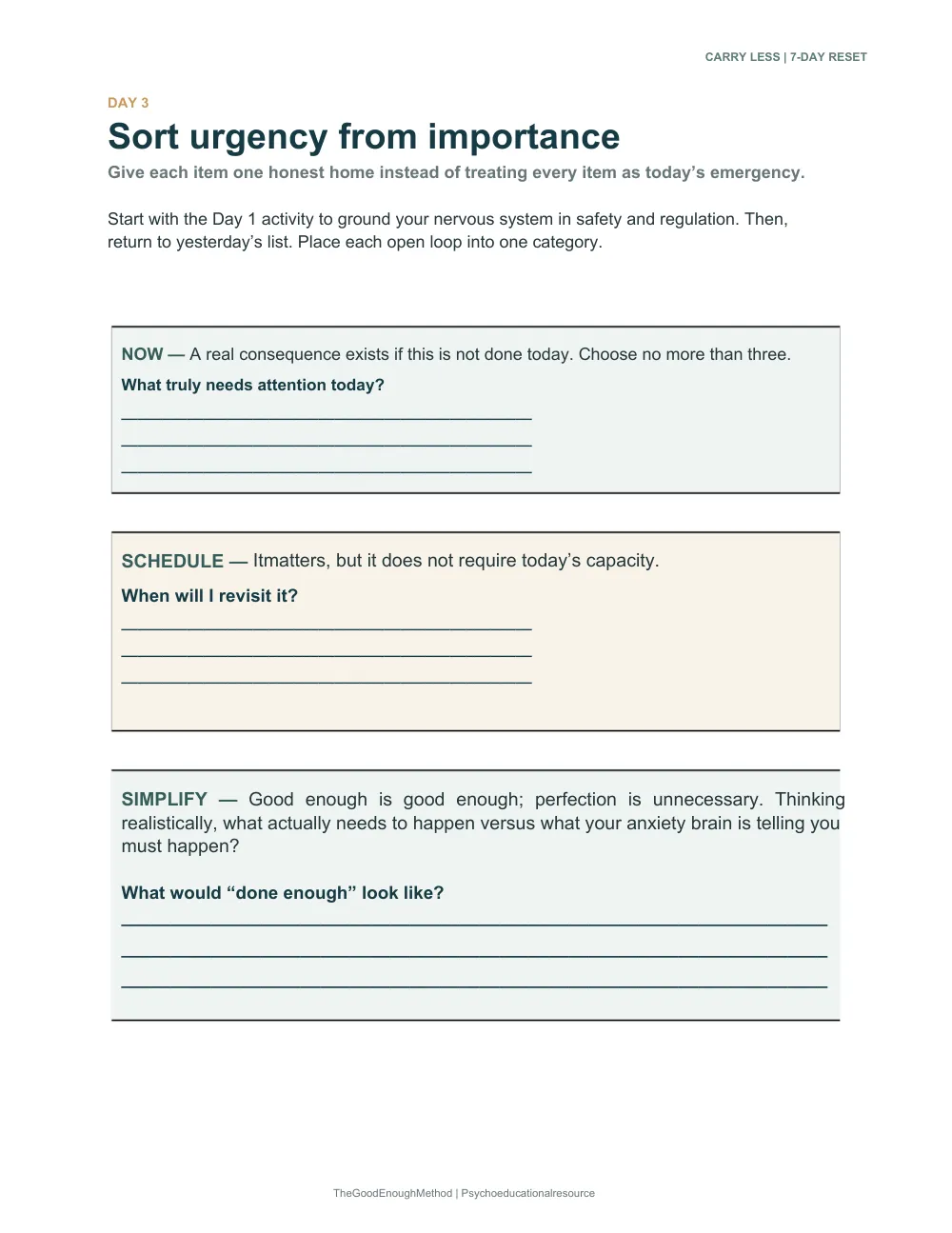
Mental-Load Sorting Worksheet
Give your mental load a place to go. Sort what needs attention now, what can wait, what can be simplified, and what can be shared.
INCLUDED
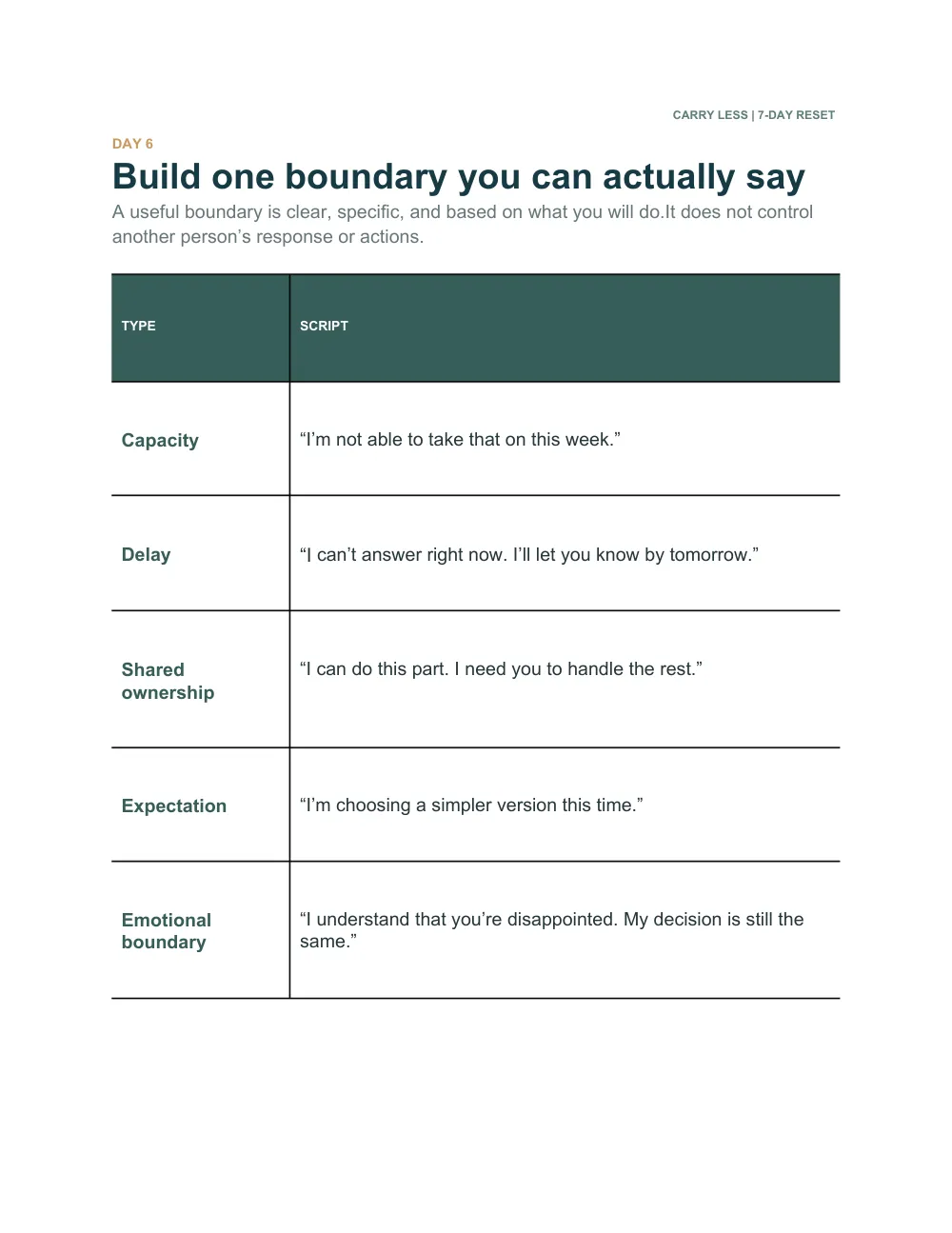
Boundary Phrase Guide
Find words for the limits you need. Five practical examples help you communicate your capacity, share responsibility, and hold a boundary when someone is disappointed.
INCLUDED
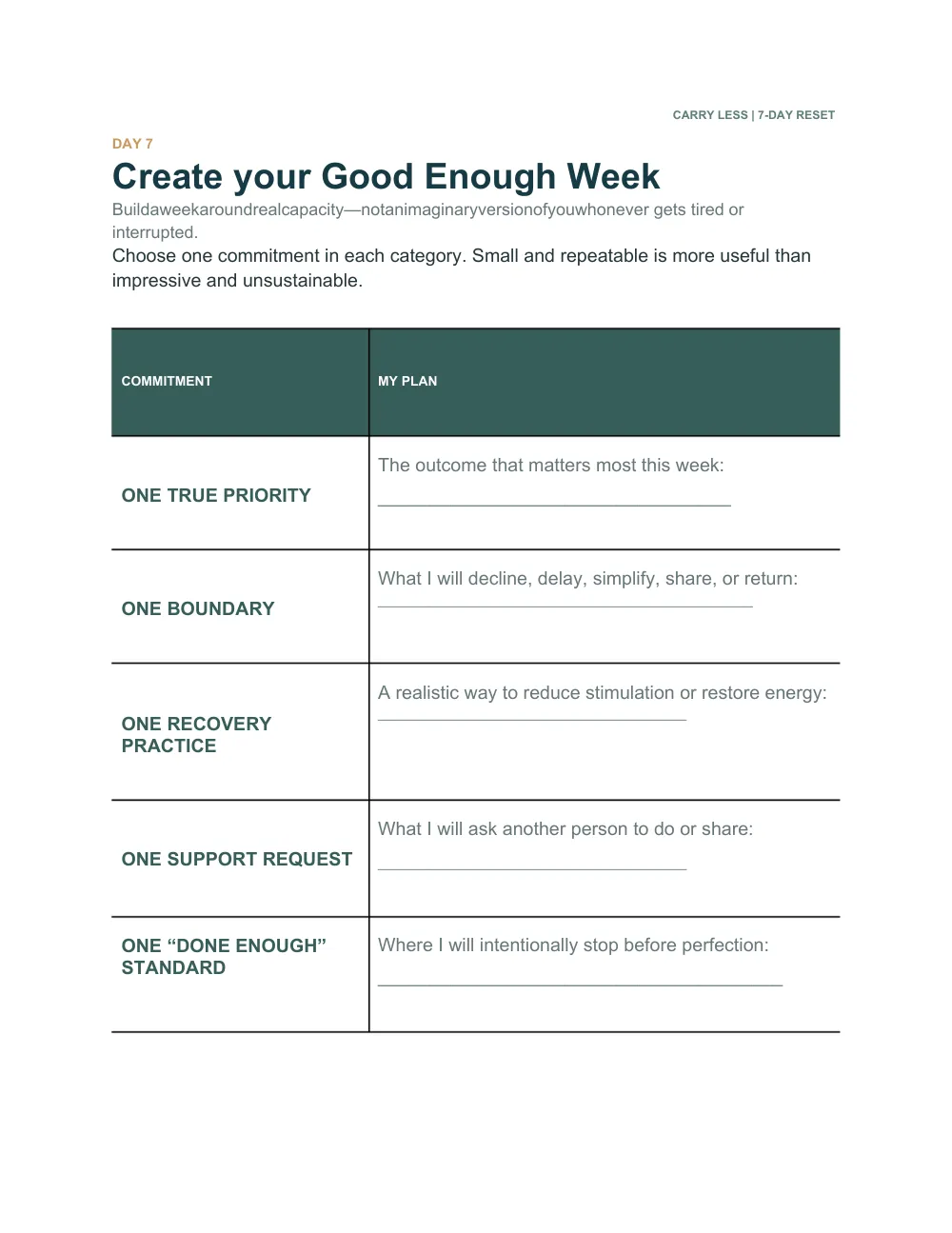
Capacity-Based Weekly Planner
Build a week around your actual capacity. Choose one priority, one boundary, one recovery practice, one support request, and a realistic stopping point.
INCLUDED
HERE'S YOUR COMPLETE Carry Less Method Workbook THAT makes your invisible mental load visible, sorts what truly needs your attention, and practices boundaries that protect your capacity.
When You purchase the Carry Less Method today, you'll get instant access to my complete system where you will learn how to:

#1: Notice the pressure
#2: See and sort the load
#3: Practice a different response
#4: Understand your Overwhelm Loop
#5: Take a starting snapshot
#6: Move through seven daily practices
#7: Find words for your boundaries
#8: Return to the 10-Minute Carry Less Reset
#9: Reflect on and decide what to give up and what to keep
#10: How to build a life that matches your capacity
You Are Backed by Our 100%Money-Back Double Guarantee
Here's Everything You're Getting Today For Just $14 (Regular Price $45 )
JUST $14 NOW - PRICE GOING UP TO $45.00 SOON!
The Complete Carry Less Method
An introduction to the Overwhelm Loop.
A baseline reflection to revisit after the seven practices.
Day 1: Connection before decision.
Day 2: Making the invisible visible.
Day 3: Sort urgency from importance.
Day 4: Find the rule underneath the pressure.
Day 5: Decide what is not yours to carry.
Day 6: Build one boundary you can actually say.
Day 7: Create a week around your real capacity.
The 10-Minute Carry Less Reset.
Integration prompts to notice what changed and what needs support.

Meet Felicia Brown
Felicia Brown helps overwhelmed women understand the mental load, guilt, perfectionism, and over-responsibility that can leave them feeling as though they are never doing enough.
Her approach translates psychological concepts into compassionate, practical tools for everyday life. Carry Less reflects that approach: notice the pattern, honor your capacity, and choose a small next step you can practice.
Carry Less is a general educational resource. Purchasing it does not create a counseling relationship or include individualized therapy or coaching.